
Every month, fees are deducted from your account without you always being able to detail them. Card fees, intervention commissions, payment method insurance: the lines add up. Banking services are not just about the price of a card.
They encompass account maintenance, credit options, app alerts, and even access to cash. Understanding what you are really paying for allows you to make a choice that suits your habits, not those of a marketing profile.
Rising bank fees: what the latest figures show
The 15th annual report from the Banking Tariff Observatory (OTB) highlights a clear trend. Between February 2025 and February 2026, banking fees increased about three times faster than inflation. The increase is approximately 2.7% over one year, compared to a general inflation rate of around 0.9%.
A survey by CLCV published in January 2026 confirms this discrepancy. The average cost of banking service baskets in mainland France rises by about 3%, and the bill for the “average consumer” profile increases by 3.8%. For a customer who does not monitor their statements, this represents several dozen euros more per year, absorbed without negotiation.
Have you ever noticed a “account maintenance fees” line appear where there wasn’t one before? This item, long free at most traditional banks, is now charged almost everywhere. Before comparing offers, it is useful to check the banking section of Vos Assurances & Banques to identify the expense items that really weigh according to your profile.

ATMs: the Cash Services network changes the game
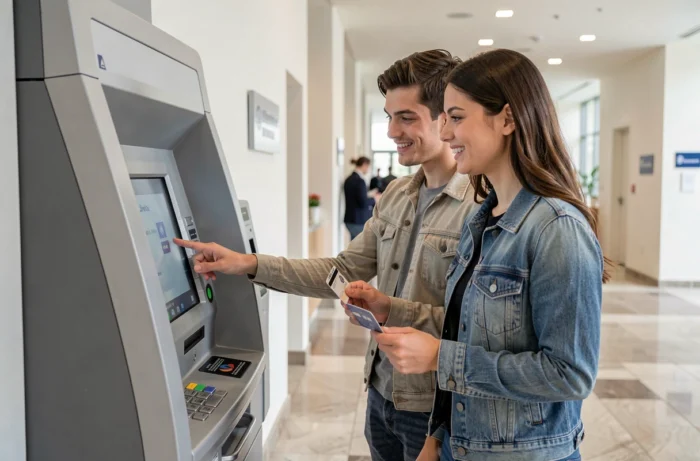
Withdrawing cash is gradually becoming different. Several major French banks are replacing their traditional ATMs with interbank machines called Cash Services. The principle: a single device shared among several institutions, installed in high-traffic locations.
This rollout, initiated in 2025, addresses a concrete problem. Maintaining a fleet of proprietary ATMs is costly for banks, especially in sparsely populated areas. Shared machines allow for cash access without multiplying underutilized machines.
What this changes for you
With Cash Services, a partner bank’s card works without additional cost on the shared machine. Check if your institution participates in the network before worrying about a closed ATM near you. Initial feedback indicates that the territorial coverage remains adequate in medium-sized cities, but some rural municipalities are losing their last traditional withdrawal point.
Bank fraud and fake advisors: protecting your account daily
Among the rapidly growing techniques, manipulation by fake bank advisors stands out. The scenario is well-rehearsed: a call, a number that resembles your bank’s, a caller who knows your name and your recent transactions.
A real advisor will never ask you to validate a transaction over the phone. If someone calls you to “secure” your account urgently, hang up and call your agency using the number on your card or statement.
An anti-fraud number soon to be operational
France is preparing a telephone verification system to combat number spoofing. The principle is to authenticate incoming calls so that your phone can alert you to a falsified number. This mechanism, still in the deployment phase, should significantly reduce scams through manipulation.
- Never share a validation code received via SMS with a telephone caller, even if they claim to be from your bank.
- Enable real-time notifications on your banking app to immediately spot any suspicious transactions.
- Report any unrecognized transaction without delay: the legal contestation period is limited, and the quicker you react, the higher the chances of reimbursement.
Overdrafts: evolving rules for customers
Overdraft authorization, often granted automatically when opening an account, may soon be subject to stricter criteria. Several news sources report a tightening in preparation, with a more detailed assessment of repayment capacity before granting this facility.
Why this change? Authorized overdrafts function like short-term credit. When they become permanent, interest accumulates, and the total cost often exceeds that of a small personal loan. Regulators want to prevent vulnerable customers from becoming mired in chronic overdrafts without realizing the cost.
Check your contract before the change
If you regularly use your overdraft, reread the terms of your account agreement. The applicable interest rate, the authorized limit, and the maximum duration are included. It’s better to request a restructuring from your advisor before the new rules restrict access to this facility.
- Compare the overall effective rate (TEG) of your overdraft with that of a small personal loan: the difference can reach several points.
- Set up a balance alert on your app to avoid slipping into unauthorized overdraft, which incurs significantly higher fees.
- In case of ongoing difficulties, the right to an account and specific offers for vulnerable customers exist in all French banking networks.
Banking services are not chosen once and for all. Fees evolve, the ATM network transforms, fraud techniques renew, and overdraft rules change. Reviewing your account agreement once a year, comparing actual rates (not promotional offers), and activating all available alerts on your app remain the most cost-effective actions for a banking customer in 2026.