Puzzle pieces end up under the couch, in the wrong box, or stuck to a sock pulled from the laundry basket. Organizing children’s puzzles doesn’t require a complex system, but a few specific habits that prevent the frustration of a missing piece in the completed picture.
Sort puzzles by size and age before choosing storage
Have you ever noticed that a wooden peg puzzle and a 100-piece cardboard puzzle have nothing in common in terms of space? Grouping them in the same furniture creates a permanent mess.
Start by separating puzzles into two categories: rigid trays (peg puzzles, wooden puzzles) and loose puzzles (classic cardboard pieces). The trays can be stored upright, like books. Loose puzzles need a closed container.
Keep age indications visible on each storage container. European regulations require age-related warnings on toys, and this marker is also useful at home. A small piece puzzle placed within reach of a two-year-old poses a safety issue, not just an organizational one.
Some practical tips on Astuces Parents allow you to adapt this sorting to the number of puzzles you actually own, without investing in unnecessary furniture.
Zip bags and marking the back: protect the pieces without multiplying boxes
The original box is often the first problem. It collapses, the lid tears, and two open boxes at the same time guarantee a mix of pieces.
Replace the box with a resealable zip bag
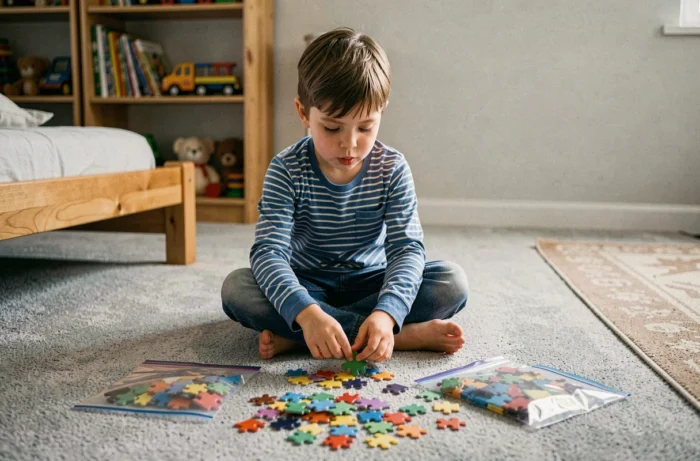
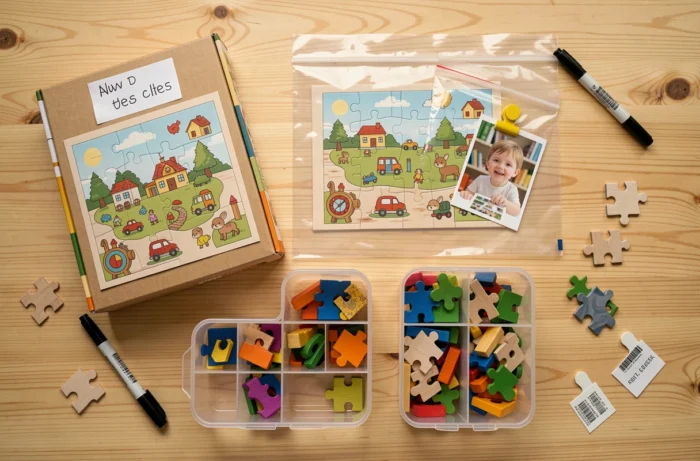
Slide all the pieces of a puzzle into a suitably sized zip bag. Cut out the image of the model from the original box lid and place it in the bag, face up. The bag takes up three times less space than a cardboard box.
This system works particularly well for small and medium-sized puzzles. For large formats, a large freezer bag is sufficient in most cases.
Mark the back of the pieces with a symbol
When two puzzles get mixed up, sorting the pieces by eye takes a considerable amount of time. A simple trick: at the time of unpacking, turn the pieces over and draw a small identical symbol on the back of each (a circle, a cross, a star).
Five minutes of marking at unpacking saves an hour of sorting later. A fine permanent marker works perfectly. Each puzzle receives its own symbol, also noted on the bag or box.
- Puzzle A: blue circle on the back of each piece
- Puzzle B: red cross
- Puzzle C: green star
- Note the correspondence on a label attached to the bag
Vertical storage of peg puzzles: save space on the shelf
Peg puzzles (those with a tray and shapes to replace) pose a specific problem. When stacked flat, they become inaccessible. The child pulls the one from the bottom, the three on top fall, and the pieces scatter.
Store the trays vertically, edge visible, like books on a shelf. A simple metal or wooden magazine holder does the trick. The child can see each puzzle at a glance and pull it out without disturbing the others.
To prevent the pieces from sliding during vertical storage, place a wide rubber band around the tray. A kitchen rubber band works well. This solution costs nothing and solves the main problem of peg puzzles: pieces falling as soon as the tray is tilted.
Rotation of puzzles: avoid boredom and limit the volume to store
Why keep thirty puzzles accessible all the time when a child uses five or six a week? Rotation is a simple principle that reduces storage volume and rekindles interest.
Select five to eight puzzles suitable for the child’s current level. Store them in the play area, at their height. The others go into a closed box, up high or in a closet.
Change the selection every two to three weeks. When a puzzle returns after an absence, the child rediscovers it with renewed enthusiasm. This rotation method also prevents visible accumulation that discourages organization.
- Only keep puzzles that the child can successfully complete alone or with minimal help accessible
- Store puzzles that are too easy (already mastered) separately to give away or circulate
- Integrate a new puzzle into the rotation each time you remove one
Puzzles that have become too simple deserve a second life. The French collection and reuse system for toys is developing, and a complete puzzle in good condition easily finds a buyer in a toy library, daycare, or among families.
Involve the child in organizing the puzzles
An organization that the child does not understand is one that they will not use. Stick a photo of the completed puzzle on each bag or on the edge of each box. The child associates the image with the container without knowing how to read.
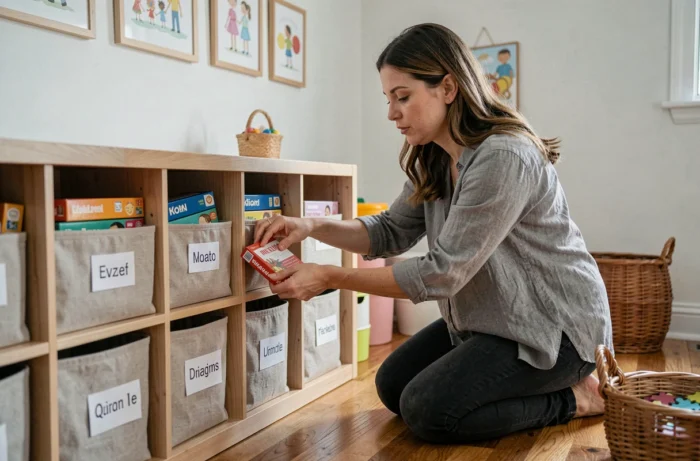
Assign a fixed location: a bin, a shelf, a drawer. A puzzle always has the same “home” in the room. This consistency helps the child integrate the act of organizing as a natural step after play.
Plan the organization before fatigue sets in. Five minutes before the end of playtime, announce that the pieces will return to their bag. A tired child or one surprised by a sudden request will resist more than a child who has been warned.
Organizing puzzles does not require dedicated furniture or a specific budget. Zip bags, a marker, a magazine holder, and regular rotation are enough to keep each piece in its place, each puzzle accessible, and each child able to find the one they want on their own.