
The savings rate of French households reached 17.4% of gross disposable income in the first quarter of 2026, according to data from the Banque de France. This figure, slightly up from previous quarters, masks a less comfortable reality: this savings reflects more of a reaction to economic uncertainty than a controlled budget surplus.
Managing personal finances on a daily basis is not just about putting money aside. It’s primarily about understanding where each euro goes and why certain habits cost more than one might think.
Dormant balance in current account: an invisible cost to your budget
Many households keep a significant amount in their current account, well beyond what their monthly expenses require. This money, which generates no return, suffers from inflation erosion month after month.
The reflex to keep a safety cushion in a checking account is understandable. However, beyond two to three months of regular expenses, every additional euro that sits in a current account represents a concrete loss of earnings.
Before seeking complex investments, it may be useful to consult the Mon Portail Finance website to identify accessible options that match your situation. The first step in daily management is not to save more, but to move the savings that already exist to a support that minimally protects it from loss of value.
Automatic savings and emergency funds: where to start concretely
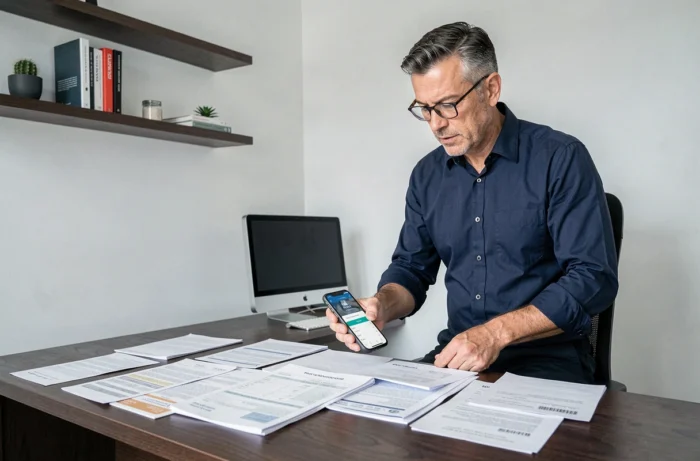
Most financial guides recommend saving a fixed percentage of salary each month. This approach works for stable incomes, but feedback varies on this point as soon as incomes fluctuate (freelancers, fixed-term contracts, part-time work).
A progressive method yields more sustainable results than a rigid goal. It relies on three concrete steps:
- Set up a modest automatic transfer (even ten euros) to a dedicated savings account, starting the day after salary payment, before the amount blends with the current budget
- Build an emergency fund covering two to three months of fixed expenses before any other form of saving or investment
- Reassess the transfer amount each quarter based on actual expenses, not a theoretical percentage
Automating the transfer is the most effective lever because it removes the daily decision. Save before spending, not with what’s left: this reversal of flow changes the budgetary dynamic without additional willpower effort.
Expense tracking in 2026: mobile payment and real-time notifications
Mobile payment accounted for one in five card payments at points of sale in 2025, according to the annual report of the Payment Means Security Observatory published in September 2026. This rapid progression changes how expenses accumulate on a daily basis.
Paying contactless with a phone makes the transaction almost invisible. The gesture is smooth, quick, and the account balance does not display at the time of purchase. This convenience has a downside: it becomes harder to physically feel the money leaving.
Activating notifications for each transaction on your banking app is a simple fix. Each alert creates a micro-moment of awareness that, accumulated over a month, alters the relationship with variable expenses. It’s not about feeling guilty over a coffee, but about making visible what has become invisible by design.
Regularly checking the list of devices authorized to make payments from your mobile wallet is also part of basic financial hygiene. An old phone still linked to your card, a forgotten shared access: these technical details have direct budgetary consequences.
Bank fees and subscriptions: recurring budget leaks

Bank fees remain a line item that many households do not account for in their monthly budget. BFMTV reminded at the end of September 2026 that these fees cover a range of items that can be difficult to decipher: card fees, intervention commissions, account maintenance fees, payment method insurance.
Comparing banking offers once a year often allows for reducing this item by several dozen euros without changing habits. Online banks offer different pricing that suits some profiles, but not all. The available data does not allow for concluding that one category of institution is systematically cheaper than another: it all depends on actual usage (number of withdrawals abroad, need for a physical branch, occasional overdraft).
On the subscription side, the accumulation of streaming services, premium apps, and underutilized plans represents a monthly expense that goes under the radar. A quarterly audit of automatic payments takes about fifteen minutes and is enough to spot lines that have become unnecessary.
Purchasing power under pressure: adapting management to an uncertain context
The pressure on purchasing power does not affect all households in the same way, but it makes daily budget management less comfortable for a large part of the population.
In this context, generic advice like “spend less” has limited impact. What works better is prioritizing expenses by category and identifying where there is actually room for maneuver. For some, it will be food (switching to short supply chains, reducing waste). For others, it will be transportation or energy.
Precautionary savings, even modest, remain the first line of defense against the unexpected. However, forcing a high savings rate when incomes are already under pressure can create counterproductive financial stress. Adjusting your budget each month rather than following a fixed rule yields better long-term results because managing personal finances is a living process, not a fixed table at the beginning of the year.