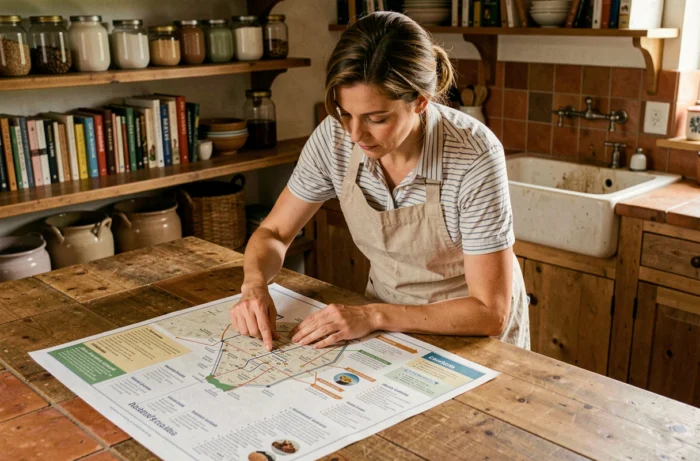
A culinary sitemap is a page that lists all the content of a site dedicated to cooking, organized by categories: recipes, techniques, ingredients, in-depth articles. Its primary function is to provide direct access to each resource without going through the main menu or the internal search engine.
Culinary taxonomy and navigation structure
The challenge specific to cooking sites lies in the multidimensional nature of a recipe. The same dish can be classified by type of cuisine (Italian, Japanese, Lebanese), by main ingredient (chicken, lentils, chocolate), by meal time (starter, main course, dessert), or by dietary restriction (gluten-free, vegan). An effective sitemap reflects this reality by offering multiple entry points rather than a linear list.
In practical terms, this means that the structure does not follow a single pattern. It crosses categories. A visitor looking for a lactose-free dessert should be able to access it from both the “desserts” branch and the “lactose-free” branch. The cross-referenced structure reduces the number of clicks to any recipe.
The L’Art du Goût sitemap illustrates this principle well by grouping its content by readable themes, allowing users to quickly identify the section that corresponds to a specific search.
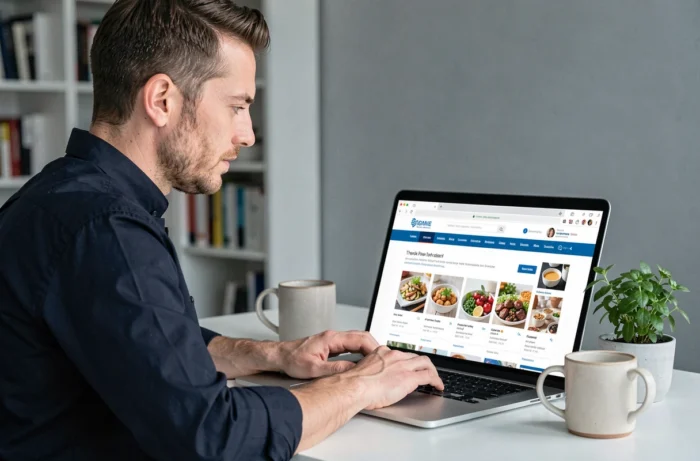
Digital accessibility and culinary sitemap from 2025
Since June 28, 2025, e-commerce sites, including those selling food products, meal kits, or online cooking classes, must comply with accessibility requirements aligned with the European standard EN 301 549 and WCAG 2.1 level AA. This obligation covers the entire user journey: homepage, recipe categories, product sheets, cart, and checkout process.
A sitemap plays a direct technical role here. For individuals navigating via keyboard or screen reader, the sitemap often serves as the most reliable path to specific content. It bypasses complex dropdown menus, image carousels, and dynamic filters that regularly pose accessibility issues.
Concrete criteria to check for an accessible sitemap
- Each link must have an explicit title: “Gluten-free pastry recipes” rather than “Click here” or a generic label that does not inform the screen reader about the destination.
- The HTML structure must adhere to a coherent heading hierarchy (H2 for main categories, H3 for subcategories) so that navigation by headings works correctly.
- Links should not open in a new tab without warning, as this behavior disorients users of assistive technologies.
- The contrast between link text and background must meet the minimum ratio required by WCAG 2.1 AA, to remain readable even on mobile screens in bright sunlight.
Meeting these criteria is not just a legal obligation. It is also a quality signal for search engines, which value sites whose structure is readable by their indexing bots.
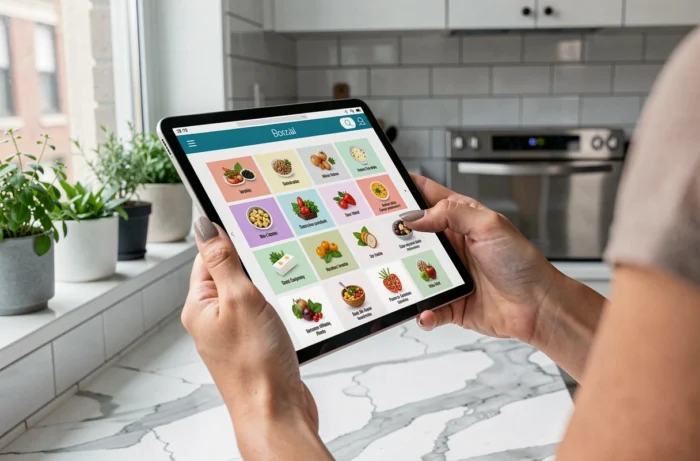
Structured lists and checklists in modern recipe sites
Recent interface design guides for culinary sites recommend integrating interactive components directly into recipe sheets: checkboxes for ingredients, step tracking with visual progress. These elements change the way a sitemap should be conceived.
When a recipe sheet contains a checklist of ingredients and a step tracker, it becomes a working tool in the kitchen, not just a page to read. The sitemap must then distinguish between consultable content and interactive content. A user returning to the site to find a recipe in preparation does not have the same need as a visitor exploring new ideas.
This distinction can be represented by a dedicated section in the sitemap, such as “My ongoing recipes” or “Recipes with step tracking,” which groups the sheets with these features. Without this signaling, the visitor does not know in advance which recipes offer this interaction.
HTML structure of the sitemap and indexing by search engines
A sitemap visible to visitors (sometimes called an HTML sitemap) does not replace the XML sitemap intended for bots. The two serve complementary functions. The HTML sitemap helps humans, while the XML sitemap helps Google and other engines discover pages.
For a culinary site that regularly publishes new recipes, the HTML sitemap must be updated with each publication. A static page created once and never updated quickly loses its relevance. CMS platforms like WordPress allow for automatic generation of this page from existing categories and tags.
What the HTML sitemap brings to SEO
Indexing bots follow internal links to discover pages on a site. An HTML sitemap creates a direct link from a higher-level page to each piece of content, which reduces crawl depth. A recipe published in a little-visited subcategory will be indexed faster if it also appears on the sitemap.
This benefit is particularly noticeable for large culinary sites, where some older recipes end up buried under several levels of pagination. The sitemap levels all pages in terms of depth.
A well-designed culinary sitemap is not just a simple inventory of links. It is a reading grid that reflects the site’s classification logic, adapts to the accessibility constraints in place since 2025, and facilitates both human navigation and the work of indexing bots. Its regular update remains the condition for it to retain its usefulness.