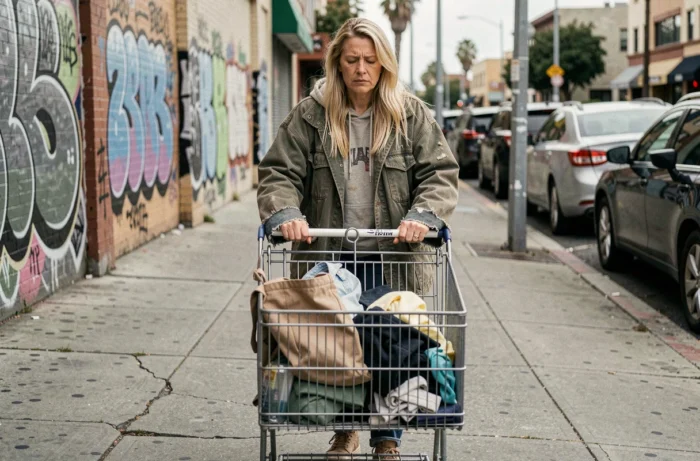
Loni Willison has been concentrating a massive volume of viral content for several years, but almost all of it relies on the same recycled clichés and an extremely simplified narrative framework. A former fitness model and ex-wife of Jeremy Jackson, the actor from Baywatch, she is currently homeless in Los Angeles. As of 2026, no official source confirms any change in her situation.
Reliability of sources on Loni Willison: what viral content distorts
The majority of content shared on TikTok, Instagram Reels, and YouTube Shorts follows an identical pattern: glamorous photos from her modeling career, followed by images taken on the street. This binary “before/after” montage generates engagement, but it does not constitute journalistic work.
No viral content creator has produced a structured interview with Loni Willison in recent years. The circulating quotes come from brief interactions captured by paparazzi, lacking context or follow-up. The same photos, sometimes dated October 2024, are reused repeatedly in 2026 publications without mentioning their age.
The problem extends beyond the Willison case. This type of content exploits the visible distress of a homeless person to feed an algorithmic format. Fact-checking is absent, and creators have no obligation to source their claims. We see here a textbook case of misinformation by omission: showing without explaining, telling without verifying.
For those seeking a more rigorous summary on Loni Willison’s story and testimonies, the few articles that cross-reference sources are far more reliable than any viral montage.
Verifiable timeline of Loni Willison: career, marriage, and divorce
Loni Willison worked as a fitness model in Los Angeles, a sector where contracts directly depend on physical condition and media visibility. Her marriage to Jeremy Jackson, who played Hobie Buchannon in Baywatch, brought her additional media exposure.
The divorce marked a turning point. The publicly documented facts essentially stop there. Here’s what is verifiable:
- Loni Willison was married to Jeremy Jackson. The divorce is confirmed by several American media sources.
- She has been observed living on the streets of Los Angeles since the latter half of the 2010s, in areas like Venice Beach, Santa Monica, and Hollywood.
- The last documented photographs in the press date back to October 2024. No credible visual updates have been published since.
- No official statement from Loni Willison, her family, or local authorities confirms her exact status in 2026.
Everything else falls into the realm of speculation. Accounts that accurately describe episodes of addiction, psychiatric diagnoses, or attempts at reintegration are not based on any public documents or verifiable direct testimonies.
Addiction and mental health: the limits of media diagnosis
Mainstream articles systematically attribute Loni Willison’s situation to addiction and mental health issues. No public medical diagnosis has ever been produced to support these claims.
Claiming that a person suffers from psychiatric disorders or addiction without a medical source, without testimony from a healthcare professional, and without the consent of the individual raises a major ethical issue. Celebrity media sidestep this difficulty by using vague formulations (“she is said to have fallen into,” “according to acquaintances”) that do not withstand verification.
Homelessness has multiple causes documented by social science research: family breakdown, job loss, lack of a social safety net, housing costs in Los Angeles. Reducing Loni Willison’s journey to an “addiction” framework obscures these structural factors.
What content creators deliberately ignore
The short format imposes a simple causal narrative. The complexity of a street journey cannot be captured in 60 seconds. Creators therefore select the most spectacular explanation, not the most accurate. Addiction gets clicks, while failures of the California healthcare system do not.
Loni Willison in 2026: absence of reliable news
A summary article dated July 2026 indicates that there is no verified element showing an improvement in her situation. An August 2026 publication claims that she is still living on the streets of Los Angeles, but without an official source to confirm it.
No recent structured interview is available. The few interactions filmed by passersby do not allow for an assessment of her actual situation. She has no presence on social media, no identified spokesperson, and no support structure that would communicate publicly about her.
This lack of reliable information is precisely what should prompt caution. Content claiming to deliver “revelations” or “unprecedented insights” about Loni Willison in 2026 relies, in almost all cases, on repackaged old material.
Media exploitation of homeless individuals: the Willison case as a symptom
The volume of content produced around Loni Willison is disproportionate to the information actually available. This discrepancy reveals a well-oiled mechanism: the visible misery of a former celebrity generates more clicks than that of an anonymous person.
The “before/after” applied to a homeless person works as a powerful emotional spring. It activates fascination with social decline, an ancient narrative register that digital platforms have industrialized. Loni Willison is not a “case”; she is a human being whose situation serves as raw material for millions of views.
The platforms do not moderate this content because it technically does not violate any community rules. Filming a person in public space remains legal in the United States. The issue is not legal; it is ethical, and it remains entirely ignored by the viral content ecosystem.
Loni Willison’s journey remains largely opaque in 2026. The only solid facts can be summarized in a few lines: fitness model, marriage to Jeremy Jackson, divorce, living on the streets of Los Angeles for several years. Everything else belongs to the realm of speculation or exploitation. As long as no direct source comes to complete this picture, the only responsible stance is to acknowledge what we do not know.