
Moving optical illusions exploit a discrepancy between what the eye captures and what the brain reconstructs. A flat surface seems to ripple, fixed circles appear to rotate, and straight lines bend under the effect of repeated contrasts. This perceptual phenomenon, studied in visual neuroscience, also forms the foundation of an artistic movement that emerged in the mid-20th century: kinetic art and Op Art.
Accessibility of optical illusion exhibitions: an often-overlooked angle
Have you ever felt a slight dizziness in front of a high-contrast black and white pattern that seems to pulse? This reaction is not trivial. Moving illusion devices can provoke real physiological effects: nausea, migraines, spatial disorientation.
Some recent presentations of this type of work now include warnings for audiences sensitive to stroboscopic patterns. The issue goes beyond mere comfort. For people with epilepsy or those prone to ocular migraines, a room saturated with high-frequency contrasts poses a real risk.
Designing a moving optical illusion exhibition that is both spectacular and accessible requires concrete scenographic choices. Three technical levers allow for this without dulling the visual experience:
- Managing ambient lighting: a sufficient light level reduces the stroboscopic effect of high-contrast patterns without eliminating the illusion itself
- Progressive zoning of the rooms, from less intense to more immersive, with clear signage at each transition so that visitors can choose their path
- Spacing out works with intense kinetic effects, interspersed with visual rest areas (neutral wall, bench, soft light) that allow the vestibular system to recalibrate
This type of adapted scenography remains rare. Most exhibitions prioritize maximum sensory density. Offering a modular path, where everyone can discover the moving optical illusion at their own pace, transforms a potentially overwhelming visit into a truly inclusive experience.

Optical-kinetic art: how the brain creates movement on a fixed surface
The technical term is illusory movement. It refers to a perception of motion in the absence of any physical movement. The brain, confronted with certain configurations of lines, contrasts, or colors, interprets the scene as dynamic.
Let’s take a simple example. A slightly distorted checkerboard, where each square is shifted a few degrees from its neighbor, produces an apparent undulation. Nothing moves on the surface. The brain detects contradictory signals between central vision and peripheral vision, filling the gap with a sensation of movement.
Recent research in artificial intelligence sheds new light on this mechanism. Computational models, trained on visual tasks, spontaneously reproduce the same perceptual errors as the human brain when faced with these patterns. The illusion is not a defect of vision but a logical consequence of its predictive functioning.
Victor Vasarely systematically exploited this mechanism. His geometric compositions, based on the repetition of shapes and complementary colors, activate these perceptual circuits almost automatically. The Vasarely Foundation in Aix-en-Provence houses monumental works where the kinetic effect operates at first glance, without any mechanical or digital device.
Vasarely, Soto, Riley: three approaches to the illusion of movement
Optical-kinetic art is not limited to a single process. Three major figures illustrate very different visual strategies for creating apparent movement.
Vasarely and modular geometry
Victor Vasarely works with plastic units, geometric shapes repeated with progressive variations in size, color, and orientation. The eye perceives a pulsation, a swelling, or a sinking of the surface. The effect relies on the regularity of the pattern and its micro-disruptions.
Soto and spatial vibration
Jesús Rafael Soto uses suspended rods in front of striped backgrounds. The slightest movement of the visitor alters the superposition of lines and generates a visual tremor. Here, the actual movement of the viewer activates the illusion, fundamentally distinguishing his approach from that of Vasarely. A recent retrospective presented at the Cité de l’architecture et du patrimoine highlighted this participatory dimension of his work.
Bridget Riley and the perceptual field
Bridget Riley pushes the black-and-white contrast to its maximum intensity. Her canvases of wavy lines provoke sensations of shimmering, sometimes dazzling. A recent exhibition at Dia Beacon allowed for the rediscovery of her large-format works in a museum space designed to let each piece breathe, with enough distance for the effect to unfold without saturating vision.
These three artists share a common point: the work only fully exists in the perception of the viewer. The canvas or sculpture is a trigger. The movement, however, is created in the visual cortex.
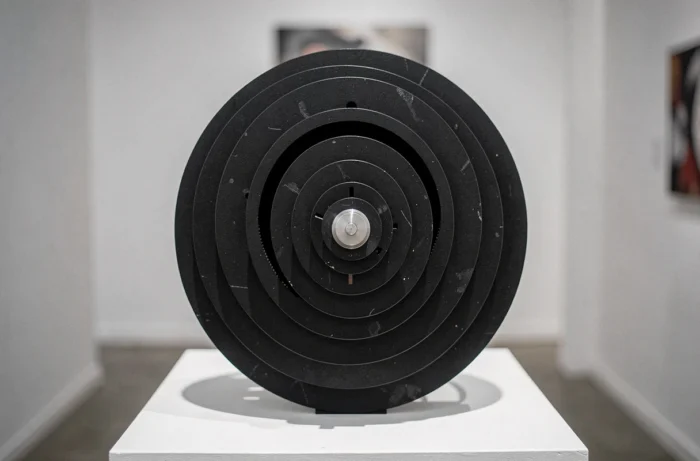
Op Art and digital art: a lineage that redefines contemporary kinetic art
The Vasarely Foundation recently hosted Margit Rosen, art historian and director of collections at ZKM in Karlsruhe, for a lecture on the relationships between optical-kinetic art and digital art. This meeting, organized as part of the European Center for Research and Resources on Optical-Kinetic Art, marks a turning point in how institutions approach this lineage.
1960s Op Art used geometry, color, and contrast to deceive the eye. Contemporary digital art has additional tools (screens, projections, motion sensors), but the underlying perceptual principles remain the same. A generative algorithm that produces moiré patterns in real-time exploits exactly the same flaws in the visual system as a Riley canvas.
Felipe Pantone, a contemporary artist who blends urban art and kinetic aesthetics, embodies this continuity. His recent installations combine lenticular surfaces, color gradients, and three-dimensional structures to create large-scale movement effects.
Kinetic art does not belong to the past. Its visual grammar permeates digital creation, spatial design, and exhibition scenography. The difference from the 1960s lies less in the processes than in the still nascent consideration of the perceptual comfort of the audiences receiving them.