
The STOP light on the Clio 3 combines several distinct alerts under one red symbol. Identifying which one is active determines the actual severity of the situation and the response to adopt. Between a collapsed oil pressure, a failing braking circuit, and a simple aging sensor sending a false signal, the consequences vary from replacing a part costing a few euros to a destroyed head gasket.
STOP Light Clio 3: Distinguishing Mechanical Failure from Electronic Fault
On aging Clio 3 models, an increasing number of STOP light activations no longer correspond to a serious mechanical failure. When the oil, coolant, and brake fluid levels are correct but the light remains on, the cause is likely electronic or related to a faulty sensor.
This phenomenon is explained by the aging of the control units and the proliferation of sensors on this model. An oxidized oil pressure switch can signal zero pressure while lubrication is functioning normally. The same logic applies to the brake fluid level sensor, whose float can seize over time.
To understand the meaning of the lights on the Clio 3 dashboard, two pieces of information must be cross-referenced: the text message displayed on the central screen (when it exists) and the vehicle’s behavior at the time of activation.
| Suspected Origin | Fluid Levels | Dashboard Message | Engine Behavior | Urgency |
|---|---|---|---|---|
| Low oil pressure | Oil below minimum | “Oil pressure” or none | Knocking noise, unstable idle | Immediate stop |
| Engine overheating | Low coolant | “Temperature” or needle in the red zone | Power loss, steam | Immediate stop |
| Braking circuit | Low brake fluid | “Minimum brake level” | Soft pedal or long travel | Quick stop |
| Sensor or control unit | All levels correct | Variable or absent | Normal | Diagnosis within a few days |
The last row of the table is one that drivers underestimate. A STOP light without visible mechanical symptoms often leads to ignoring the alert, while an OBD diagnostic can clarify the situation in just a few minutes.
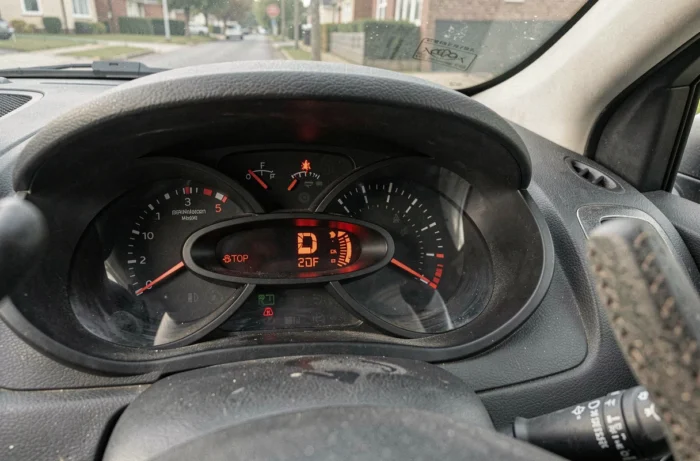
Fan Thermoswitch: The Sneaky Failure in Traffic
Among the causes of the STOP light that are rarely detailed in consumer guides, the thermoswitch (or temperature switch) of the radiator fan deserves special attention on the Clio 3.
Its role is simple: to trigger the cooling fan when the coolant temperature exceeds a certain threshold. When this component fails, the fan does not start. In smooth traffic, the natural airflow partially compensates. However, when stopped or in a traffic jam, the temperature rises without regulation.
The typical scenario follows a precise sequence:
- The vehicle drives normally on the road, with no visible alert on the dashboard.
- Stopped in a traffic jam or at a prolonged red light, the temperature needle gradually rises into the red zone.
- The coolant reaches its boiling point, the STOP light comes on, sometimes accompanied by steam escaping from under the hood.
If the engine is not turned off immediately at this stage, the head gasket may be burned, with repair costs far exceeding those of the thermoswitch itself. Checking the fan activation at idle with a hot engine (listening for it to start after a few minutes) is a preventive test accessible to any driver.
OBD Diagnosis on Clio 3: Reading Fault Codes Related to the STOP Light
The STOP light on the Clio 3 is not associated with a single fault code. It is controlled by the engine control unit (injection) or by the body control unit depending on the nature of the alert. A OBD reader connected to the diagnostic port (located under the steering wheel, on the left side) allows for retrieving stored codes.
The distinction between an engine code (family P0xxx or P1xxx) and a body or network code (family U or C) directly guides the diagnosis. A code P0520 points to the oil pressure circuit. A code related to the cooling circuit (thermostat, temperature sensor) confirms the thermal issue.
Without a diagnostic tool, two manual checks remain useful:
- Visually check the three critical levels: engine oil, coolant (cold engine), brake fluid.
- Observe whether the light comes on only at startup and then goes off (normal operation of the automatic test) or if it stays on while driving.
- Note if a text message accompanies the light, as it significantly narrows down the possible causes.
A light that comes on briefly and then disappears when hot may indicate a sensor at the end of its life sending an erratic signal when cold. This behavior is common on high-mileage Clio 3 models, particularly on the oil pressure switch.
When the STOP Light Accompanies the Battery or Alternator Light
The simultaneous illumination of the STOP light and the battery light generally indicates a failure of the alternator. Without sufficient charge, the oil pressure drops (the oil pump being driven by the engine which eventually stalls), and several lights come on in succession.
In this situation, the vehicle runs on battery reserve. The remaining range depends on electrical consumption: turning off the air conditioning, radio, and non-essential lights can extend the journey to a safe stopping point. Do not attempt to restart if the engine stalls: the battery will likely not have enough charge to restart the starter.

Cost and Priority of Common Repairs Related to the STOP Light
Interventions triggered by a STOP light on Clio 3 cover a wide spectrum. An oil pressure switch or a fan thermoswitch represents a low-cost part and limited labor time. A head gasket resulting from untreated overheating shifts the bill into a completely different order of magnitude.
The key data: the speed of reaction determines the final amount. Turning off the engine as soon as the STOP light comes on in case of mechanical symptoms (noise, steam, power loss) almost always prevents worsening. Driving “a little longer to see” turns a minor repair into a heavy replacement.
The red STOP light on the Clio 3 remains a binary signal: either the cause is mechanical and stopping is non-negotiable, or it is electronic and a diagnostic check is sufficient. Checking fluid levels before any other action remains the first reflex to have, regardless of the context of activation.